 10.34920/2181-8207/2026/1-211

Annotation. Purpose: This paper examines the growing problem of predatory publishing and its implications for early career researchers (ECRs). It seeks to identify why ECRs are especially vulnerable and to propose strategies for avoiding such traps.
Methods: A qualitative, integrative review was conducted, drawing on peer-reviewed literature, policy reports, and case examples published between 2010 and 2024. Thematic analysis was used to synthesize findings across categories including definitions, impacts, and mitigation strategies.
Results: The review reveals that predatory journals exploit open access publishing models by offering rapid but false peer review, misleading indexing claims, and hidden fees. ECRs are disproportionately targeted due to publication pressures, limited awareness, and lack of mentorship. The consequences include reputational harm, diminished visibility, and the erosion of trust in scholarly communication.
Conclusion: Combating predatory publishing requires coordinated action at multiple levels. For ECRs, critical evaluation skills, mentorship, and publishing literacy are key safeguards. Institutions must prioritize quality over quantity in research assessment, while international organizations can strengthen awareness campaigns and global guidelines. Together, these measures can help protect researchers and preserve the integrity of scholarly communication.
Keywords: Predatory Publishing, Early Career Researchers (ECRs), Scholarly Communication, Research Integrity, Open Access, Academic Publishing Ethics, Institutional Policy
Аннотация. Мақсад: Ушбу мақолада cохта даврий нашриётларнинг тобора ортиб бораётган муаммоси ва унинг ёш тадқиқотчилар (ECR) учун оқибатлари ўрганилади. Унда ECRларнинг нима учун, айниқса, заиф эканлиги аниқланади ва бундай тузоқлардан қочиш стратегиялари таклиф қилинади.
Усуллар: 2010 ва 2024 йиллар оралиғида нашр этилган экспертлар томонидан кўриб чиқилган адабиётлар, сиёсат ҳисоботлари ва мисоллар асосида сифатли, интегратив кўриб чиқиш ўтказилди. Таърифлар, таъсирлар ва юмшатиш стратегиялари каби тоифалар бўйича топилмаларни умумлаштириш учун тематик таҳлил қўлланилди.
Натижалар: Таҳлиллар шуни кўрсатадики, сохта журналлар тезкор, аммо ёлғон экспертлар томонидан кўриб чиқиш, чалғитувчи индекслаш даъволари ва яширин тўловларни таклиф қилиш орқали очиқ кириш нашриёт моделларидан фойдаланадилар. ECRлар нашр босими, чекланган хабардорлик ва устозликнинг йўқлиги туфайли номутаносиб равишда нишонга олинади. Оқибатлар обрўга путур етказиш, кўринишнинг пасайиши ва илмий мулоқотга ишончнинг пасайишини ўз ичига олади.
Хулоса: Сохта даврий нашриётларга қарши курашиш кўп даражаларда мувофиқлаштирилган ҳаракатларни талаб қилади. ECRлар учун танқидий баҳолаш кўникмалари, устозлик ва нашриёт саводхонлиги асосий ҳимоя чоралари ҳисобланади. Институтлар тадқиқотни баҳолашда миқдордан кўра сифатга устувор аҳамият беришлари керак, халқаро ташкилотлар эса хабардорлик компаниялари ва глобал кўрсатмаларни кучайтириши мумкин. Биргаликда, бу чоралар тадқиқотчиларни ҳимоя қилишга ва илмий алоқаларнинг яхлитлигини сақлашга ёрдам беради.
Калит сўзлар: Сохта даврий нашриёт, ёш тадқиқотчилари (ECR), илмий мулоқот, тадқиқот яхлитлиги, очиқ кириш, академик нашриёт етакчиси, институционал сиёсат
Аннотация. Цель: В данной статье рассматривается растущая проблема хищнического издательского дела и ее последствия для молодых исследователей (МИ). Цель состоит в том, чтобы определить, почему МИ особенно уязвимы, и предложить стратегии для избежания подобных ловушек.
Методы: Был проведен качественный интегративный обзор, основанный на рецензируемой литературе, политических отчетах и примерах из практики, опубликованных в период с 2010 по 2024 год. Для обобщения результатов по категориям, включая определения, последствия и стратегии смягчения последствий, использовался тематический анализ.
Результаты: Обзор показывает, что хищнические журналы используют модели публикации в открытом доступе, предлагая быструю, но ложную экспертную оценку, вводящие в заблуждение заявления об индексации и скрытые сборы. МИ непропорционально часто становятся объектом таких действий из-за давления со стороны издателей, ограниченной осведомленности и отсутствия наставничества. Последствия включают в себя ущерб репутации, снижение видимости и подрыв доверия к научной коммуникации.
Вывод: Борьба с хищническим издательским делом требует скоординированных действий на нескольких уровнях. Для молодых исследователей ключевыми гарантиями являются навыки критической оценки, наставничество и грамотность в вопросах публикаций. Учебные заведения должны отдавать приоритет качеству, а не количеству при оценке исследований, в то время как международные организации могут усилить информационные кампании и глобальные руководящие принципы. Вместе эти меры могут помочь защитить исследователей и сохранить целостность научной коммуникации.
Ключевые слова: Хищнические публикации, Молодые исследователи, Научная коммуникация, Научная этика, Открытый доступ, Этика академических публикаций, Институциональная политика
Introduction
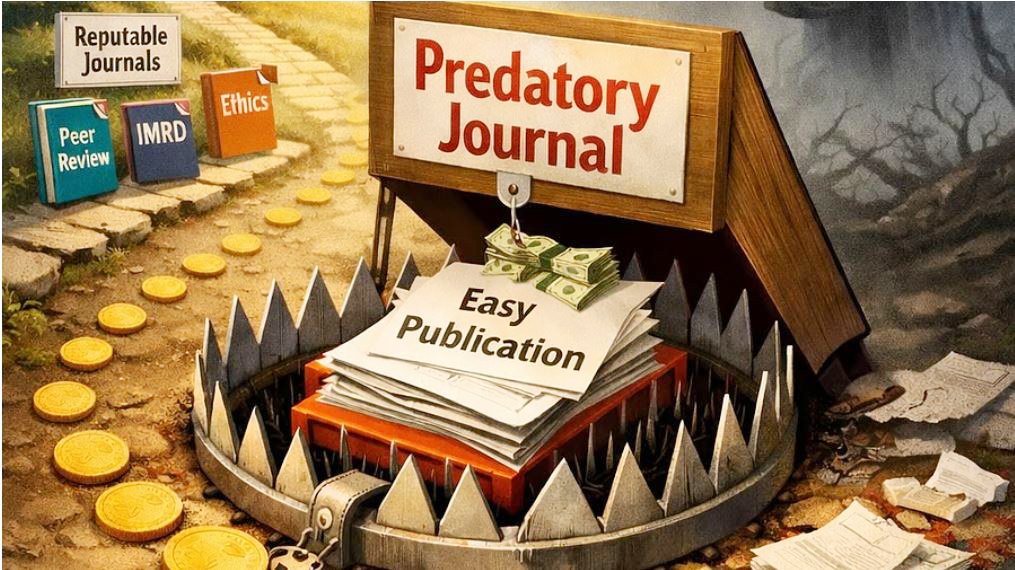
The rapid growth of open access publishing has transformed scholarly communication, making research more visible and accessible across disciplines and geographies. However, alongside legitimate open access initiatives, the rise of predatory publishers has created significant challenges for the integrity of academic publishing. Predatory journals exploit the pressure to publish by charging high publication fees without providing the essential editorial and peer-review standards that safeguard scholarly quality. Their deceptive practices–ranging from false impact factor claims to aggressive email solicitations–have misled thousands of researchers worldwide.
For early career researchers, who often face immense pressure to build their academic profiles quickly, the risks are particularly acute. Many lack the experience to distinguish between reputable journals and fraudulent ones, leaving them vulnerable to manipulation. Falling into the trap of predatory publishing not only wastes time and resources but can also damage reputations, undermine career advancement, and contribute to the broader erosion of trust in scholarly communication.
This paper examines the phenomenon of predatory publishing with a specific focus on the challenges faced by early career researchers. It highlights the defining characteristics of predatory journals, explores their consequences for individual scholars and the academic community, and outlines practical strategies to avoid exploitation. By equipping early career researchers with awareness and critical tools, the paper aims to promote ethical publishing practices and protect the integrity of academic scholarship.
Problem Statement
The academic publishing landscape has undergone a dramatic shift with the proliferation of open access journals. While many of these outlets are reputable and play a vital role in democratizing knowledge, the same environment has allowed predatory publishers to thrive. These publishers exploit the «publish or perish» culture by presenting themselves as legitimate while bypassing rigorous peer review, editorial oversight, and quality control. Their practices include misleading claims about impact factors, falsified editorial boards, and aggressive solicitation of manuscripts. The scale and persistence of this phenomenon have turned predatory publishing into a systemic problem for the global academic community.
Early career researchers are disproportionately vulnerable to predatory publishers. Unlike established scholars, they may lack the necessary experience, mentorship, or awareness to critically evaluate publishing outlets. The desire to rapidly build a strong CV often makes them more receptive to unsolicited invitations promising quick publication and international visibility. In some cases, institutional pressures to meet publication quotas intensify the temptation to publish in these outlets, even when warning signs are present. This vulnerability increases the likelihood that early career researchers will inadvertently contribute to the growth and legitimacy of predatory journals.
The consequences of falling into this trap are significant. On an individual level, publishing in predatory journals can harm a researcher’s reputation, limit the credibility of their work, and undermine future career opportunities. At the institutional and disciplinary levels, the spread of low-quality publications weakens the reliability of research output and dilutes the global knowledge base. Moreover, in countries where evaluation systems prioritize publication quantity over quality, predatory journals often exploit the gap, perpetuating cycles of academic exploitation and misinformation (Cobey et al., 2017).
Despite increasing awareness campaigns and the availability of resources such as journal whitelists and blacklists, the problem persists (Strinzel et al, 2019). Predatory publishers adapt quickly, adopting more sophisticated tactics that blur the line between legitimate and illegitimate outlets. This makes it increasingly difficult for inexperienced researchers to distinguish between trustworthy journals and fraudulent ones. Addressing this problem requires not only individual vigilance but also structural reforms in academic evaluation, mentorship, and institutional support. Without targeted action, early career researchers will remain the most at-risk group, perpetuating both personal and systemic harm.
Literature Review
1. Defining Predatory Publishing
The concept of «predatory publishing» was first popularized by Jeffrey Beall (2012), who described it as exploitative open access practices that charge publication fees without offering legitimate editorial and peer-review services. While definitions vary, common characteristics include fake or exaggerated impact factors, misleading indexing claims, and false affiliations of editorial board members (Cobey et al., 2017). These journals thrive by mimicking legitimate open access models, thereby blurring the line for unsuspecting researchers, especially those new to academic publishing (Eriksson and Helgesson, 2017).
2. The Scale and Growth of Predatory Journals
Studies have shown exponential growth in the number of predatory journals over the past decade. Shen and Björk (2015) estimated that the number of articles published in predatory journals rose from a few thousand in 2010 to over 400,000 annually by 2014. This trend continues as digital publishing lowers entry barriers for fraudulent operations. The international nature of the problem means that predatory journals affect both developed and developing countries, although researchers in low- and middle-income countries appear particularly targeted due to systemic publication pressures (Grudniewicz et al., 2019).
3. Impact on Researchers and the Academic Community
The consequences of predatory publishing are severe at both individual and systemic levels. For researchers, articles in predatory outlets often go unnoticed by reputable indexing services, reducing visibility and impact (Frandsen, 2019). Worse, association with such journals can damage a scholar’s reputation and credibility. At the systemic level, predatory journals flood the scholarly record with low-quality or even fraudulent research, undermining trust in academic publishing (Moher et al., 2017). This weakens the evidence base that underpins scientific, medical, and policy decision-making.
4. Early Career Researchers as a Vulnerable Group
Literature emphasizes that early career researchers (ECRs) are at particular risk. Christopher and Young (2015) argue that ECRs are often targeted by mass solicitations promising rapid publication and international exposure. Factors such as limited awareness of journal evaluation tools, pressure to publish quickly, and lack of mentorship contribute to this vulnerability (Memon, 2019). In some contexts, institutional systems that prioritize publication numbers over quality further incentivize risky decisions. Consequently, ECRs inadvertently sustain the growth of predatory publishing by providing it with content and fees.
5. Tools and Resources to Identify Predatory Journals
Several initiatives have emerged to help researchers identify and avoid predatory outlets. Beall’s List (now archived) was an early attempt, followed by alternatives such as Cabells’ Predatory Reports and the Directory of Open Access Journals (DOAJ) whitelist (Beall, 2016). Journals indexed in Web of Science or Scopus are often considered more credible, although predatory publishers increasingly mimic legitimate indexing claims (Machado and Maia, 2020; Macháček and Srholec, 2021). Awareness campaigns by organizations such as COPE (Committee on Publication Ethics) and IFLA highlight red flags such as lack of peer review, unclear fees, and overly broad journal scopes.
6. Current Strategies and Ongoing Challenges
Although significant efforts have been made to combat predatory publishing, challenges remain. As Demir (2018) notes, predatory publishers continuously evolve, adopting professional-looking websites, fake metrics, and even hijacked journal identities. Education and training are therefore critical components of prevention. Several studies recommend embedding scholarly communication literacy into graduate curricula and providing mentorship to ECRs (Patwardhan, 2019). Institutional reforms–such as rewarding quality over quantity and raising awareness through workshops–are also seen as necessary steps to reduce susceptibility to predatory practices.
Methodology
This study adopts a qualitative, integrative review approach to explore the phenomenon of predatory publishing and its implications for early career researchers (ECRs). Rather than collecting new primary data, the research synthesizes existing scholarly literature, policy reports, and professional guidelines to identify common themes, risks, and solutions.
First, a systematic literature search was conducted using academic databases such as Scopus, Web of Science, Google Scholar, and ResearchGate, focusing on peer-reviewed articles, reports, and conference papers published between 2010 and 2024. Keywords included «predatory publishing,» «early career researchers,» «academic integrity,» «open access challenges,» and «journal evaluation tools.» Reference lists of key papers were also screened to capture additional relevant sources.
Second, the study employed thematic analysis to organize findings into core categories: (1) definitions and characteristics of predatory publishing, (2) global and regional trends in predatory journals, (3) impacts on researchers and scholarship, (4) the particular vulnerabilities of ECRs, and (5) mitigation strategies and resources. This structure guided both the literature review and the subsequent discussion.
Third, a case-based illustrative method was used to highlight examples from different contexts. This included documented cases of predatory journals in developing countries, policy responses from research institutions, and best-practice guidelines promoted by international organizations such as COPE, IFLA, and UNESCO. These cases enrich the analysis by grounding theoretical insights in real-world practices.
Finally, the methodology acknowledges its limitations, particularly the reliance on secondary sources and the evolving nature of predatory publishing. As predatory journals adapt and disguise themselves with greater sophistication, some recent practices may remain under documented. Nevertheless, by combining a structured review of existing research with illustrative cases, the study provides a robust basis for deriving lessons and actionable recommendations for ECRs.
Results and Discussion
1. Characteristics of Predatory Journals
The review confirmed that predatory journals display a consistent set of features that distinguish them from legitimate outlets. These include:
Absence of transparent peer review, with manuscripts often accepted within a few days.
Aggressive email solicitations promising rapid publication and wide visibility.
Misleading indexing claims, where journals falsely state inclusion in Scopus or Web of Science.
Opaque or hidden fees, typically revealed only after manuscript acceptance.
Questionable editorial boards, sometimes listing non-consenting or fabricated scholars.
For ECRs, these characteristics are not always obvious, especially when a journal’s website is professionally designed. The lack of clarity between legitimate open access models and predatory operations deepens confusion, making training in critical evaluation essential.
2. The Scale of the Problem for Early Career Researchers
The findings highlight that ECRs are disproportionately targeted by predatory publishers. Global surveys reveal that more than 30% of submissions to predatory journals come from early-career academics, particularly from low- and middle-income countries where publication pressure is intense (Frandsen, 2019). Many of these researchers lack access to experienced mentors or institutional support systems.
For example, in Russia, India, and parts of Africa, institutional promotion criteria still reward quantity over quality, which unintentionally incentivizes researchers to seek «easier» publishing routes. This structural problem perpetuates the growth of predatory journals while simultaneously undermining the credibility of younger scholars’ work.
3. Consequences for Academic Careers and Scholarship
Publishing in predatory journals has both immediate and long-term consequences. On the individual level, ECRs risk losing credibility, as work published in predatory outlets often remains unrecognized by hiring committees, grant evaluators, or ranking systems. On a systemic level, the academic record is diluted with low-quality, non-peer-reviewed articles, which in turn erodes trust in scholarly communication.
Moreover, once a paper is published in a predatory journal, withdrawing it is difficult, and republishing in a reputable outlet is often impossible due to duplication rules. Thus, a single misstep early in a career can leave a lasting mark on a researcher’s portfolio.
4. Tools and Strategies for Identifying Predatory Journals
The study found a variety of tools and practical strategies to help ECRs avoid predatory traps. These include:
Using whitelists such as DOAJ (Directory of Open Access Journals) and indexes like Scopus/Web of Science.
Checking publisher transparency through COPE (Committee on Publication Ethics) membership.
Consulting Cabells’ Predatory Reports, though this may be cost-prohibitive in some regions.
Evaluating journal practices: Are peer-review timelines realistic? Is the editorial board verifiable?
Simple heuristics–such as avoiding journals with vague scopes, exaggerated impact claims, or unverifiable contact information–can also empower ECRs to make safer decisions.
5. Lessons for Early Career Researchers
From the synthesis of literature and case studies, several key lessons emerge for ECRs:
1. Quality over quantity: It is better to publish fewer papers in reputable journals than many in predatory outlets.
2. Seek mentorship: Guidance from supervisors, librarians, or senior colleagues can help evaluate journals.
3. Invest in awareness: Attending workshops on scholarly communication builds resilience against predatory tactics.
4. Use institutional resources: Many universities provide training modules and access to legitimate journal evaluation databases.
These lessons emphasize that proactive awareness and critical evaluation are essential professional skills in the digital publishing era.
6. Institutional and Global Responsibilities
While individual researchers carry responsibility, the discussion also highlights the role of institutions and the global academic community. Universities should prioritize mentorship, provide access to resources such as Cabells, and revise promotion criteria that reward quality and ethical publishing. At a global level, organizations like UNESCO and IFLA advocate for capacity-building initiatives, especially in developing countries where the threat of predatory publishing is most acute.
Ultimately, combating predatory journals requires a multi-level strategy (Xia et al, 2015):
Individual responsibility through awareness and vigilance.
Institutional reform to reshape incentives and provide training.
Global cooperation to strengthen academic integrity and raise awareness.
Conclusion and Recommendations
1. Summary of Key Findings
This study has shown that predatory publishing poses a serious threat to the credibility and sustainability of scholarly communication. Early career researchers (ECRs) are particularly vulnerable, given their limited experience, strong pressure to publish, and frequent lack of access to mentorship. The findings reveal that predatory journals exploit open access models by offering rapid but non-existent peer review, misleading indexing claims, and hidden fees. These practices not only harm individual careers but also contaminate the global body of scientific knowledge.
2. Implications for Early Career Researchers
For ECRs, avoiding predatory publishers is more than a matter of professional caution–it is essential for establishing a credible research trajectory. Awareness of the characteristics of predatory journals, combined with a strong commitment to publishing quality over quantity, will help young scholars build solid academic reputations. Proactive engagement in training, mentorship, and the use of reliable journal evaluation tools can serve as safeguards against making costly mistakes in the early stages of a career.
3. Recommendations for Researchers
To strengthen resilience against predatory publishing, ECRs should:
1. Critically evaluate journals using established whitelists (e.g., DOAJ, Scopus, Web of Science).
2. Consult mentors and librarians before submitting to unfamiliar outlets.
3. Participate in institutional workshops on scholarly communication and research ethics.
4. Prioritize transparency and rigor in selecting publishing venues, recognizing that visibility without credibility undermines long-term academic growth.
4. Recommendations for Institutions
Universities and research organizations share a responsibility to mitigate the risks of predatory publishing. They should:
Provide training programs on research ethics and scholarly publishing for students and staff.
Offer institutional subscriptions to resources like Cabells’ Predatory Reports.
Reform promotion and evaluation policies (Resnik, Wager and Kissling, 2015) to reward quality over numerical output.
Encourage the role of academic libraries as central hubs for publishing literacy initiatives.
5. Global and Policy-Level Responses
At the international level, organizations such as UNESCO, COPE, and IFLA can play pivotal roles in combating predatory publishing by promoting global guidelines, supporting awareness campaigns, and fostering collaboration across countries. Developing nations, in particular, need capacity-building initiatives to protect their research communities from exploitation.
6. Final Reflections
In conclusion, the fight against predatory publishing requires a multi-layered response that integrates individual vigilance, institutional reform, and global collaboration. For early career researchers, the path forward lies in cultivating critical publishing literacy and aligning their scholarly output with the principles of transparency, integrity, and rigor. By learning to recognize and avoid predatory traps, ECRs can safeguard their careers while contributing to the health of global science.
References:
Beall, J. (2016). Dangerous predatory publishers threaten medical research. Journal of Korean Medical Science, 31: 1511-1513. https://doi.org/10.3346/jkms.2016.31.10.1511
Cobey, K.D., et al. (2017). What is a predatory journal? A scoping review. F1000Research, 6:1001. https://doi.org/10.12688/f1000research.11407.1
Christopher, M.M. and Young, K.M. (2015). Awareness of «predatory» open-access journals among prospective veterinary and medical authors attending scientific writing workshops. Frontiers in Veterinary Science, 2: 22. https://doi.org/10.3389/fvets.2015.00022
Demir, S.B. (2018). Predatory journals: Who publishes in them and why? Journal of Informetrics, 12: 1296-1311. https://doi.org/10.1016/j.joi.2018.10.008
Eriksson, S. and Helgesson, G. (2017). The false academy: Predatory publishing in science and bioethics. Medicine, Health Care and Philosophy, 20: 163-170. https://doi.org/10.1007/s11019-016-9740-3
Frandsen, T.F. (2019). Why do researchers decide to publish in questionable journals? A review of the literature. Learned Publishing, 32: 57-62. https://doi.org/10.1002/leap.1214
Grudniewicz, A., et al. (2019). Predatory journals: No definition, no defence. Nature, 576: 210-212. https://doi.org/10.1038/d41586-019-03759-y
Macháček, V. and Srholec, M. (2021) Predatory publishing in Scopus: Evidence on cross-country differences. Scientometrics, 126: 1897–1921. https://doi.org/10.1007/s11192-020-03752-7
Memon, A.R. (2019). Predatory journals spamming for publications: What should researchers do? Science and Education, 6: 40-43. https://doi.org/10.6087/kcse.157
Moher, D., et al. (2017). Stop this waste of people, animals and money. Nature, 549: 23-25. https://doi.org/10.1038/549023a
Patwardhan, B. (2019). Why India is striking back against predatory journals. Nature, 571: 7. https://doi.org/10.1038/d41586-019-02023-7
Resnik, D.B., Wager, E. and Kissling, G.E. (2015). Retraction policies of top scientific journals ranked by impact factor. Journal of Medical Library Association, 103: 136-139. https://doi.org/10.3163/1536-5050.103.3.006
Shen, C. and Björk, B.C. (2015). ‘Predatory’ open access: A longitudinal study of article volumes and market characteristics. BMC Medicine, 13: 230. https://doi.org/10.1186/s12916-015-0469-2
Strinzel, M., et al. (2019). Blacklists and whitelists to tackle predatory publishing: A cross-sectional comparison and thematic analysis. mBio, 10: e00411-19. https://doi.org/10.1128/mBio.00411-19
Xia, J., et al. (2015) Who publishes in «predatory» journals? Journal of the Association for Information Science and Technology, 66: 1406-1417. https://doi.org/10.1002/asi.23265