 10.34920/2181-8207/2023/2-056



Annotation: A systematic and integrative reviews as the types of analytical information products are studied. The presented data on the publications dynamics of systematic and integrative reviews showed their high relevance as analytical information products, especially in the field of medicine, biochemistry, social sciences.
The essential comparative analysis of the concepts «systematic review», «integrative review» has shown that these types of reviews have both common features (generalization, synthesis, combining data from primary sources on the review topic, scientific methods of data evaluation and methods of information analysis, scientifically based conclusions) and distinctive features (data source selection strategy, methods to assess data, nature of conclusions and others). Their knowledge can increase the involvement of library staff in preparing these types of reviews.
It is shown how research libraries could participate in these processes in the framework of their scientific and information activities. Thus, libraries can expand their list of analytical information products and services that they provide to scientists and specialists.
Key words: information analytical products, systematic review, analytical review, integrative review, research library
Аннотация: Изучаются систематический и интегративный обзоры как виды обзорно-
аналитических продуктов. На основе анализа публикаций показано, что особое внимание при создании этих видов обзоров уделяется методике их подготовки. Проводится анализ динамики документопотока по систематическим и интегративным обзорам, который позволил показать распределение обзоров по отраслям знания, организациям, принимающим участие в написании систематических и интегративных обзоров, и выявить определенные тенденции в развитии данного вопроса. Дается сущностный анализ понятий «систематический обзор», «интегративный обзор». Проведенный сравнительный анализ систематического, интегративного и аналитического обзоров показал, что эти виды обзоров имеют как общие черты (обобщение, синтез, объединение данных из первоисточников по теме обзора, научность методов оценки данных и способов информационного анализа, научно обоснованные выводы), так и отличительные особенности (стратегия отбора источников данных, методы оценки данных, характер выводов и др.). Показано, как научные библиотеки могли бы участвовать в подготовке систематических и интегративных обзоров в рамках своей научно-информационной деятельности.
Ключевые слова: информационно-аналитические продукты, систематический обзор, аналитический обзор, интегративный обзор, академическая библиотека
The transition to digital culture, including science as a communicative structure, raised the question of the role of research libraries in the research process. The study of information needs and information behavior of scientists and specialists showed a significant interest in information review and analytical products, due to the exponential growth of the world documentary flow in the electronic environment, the increase in duplication and dispersion of publications on the topic, the rapid obsolescence of scientific information in some areas, etc.
As is known there is an alternative to the flow of numerous primary and secondary documents which are to be searched and assessed. It is review and analytical products, which systematize and summarize the results of many studies. They allow scientists and specialists to be aware of research results, due to the functions they may perform – integrative and evaluative ones. This determines the value of analytical products for information research support.
Bibliographic, abstract and analytical reviews and methods of their preparation in research libraries and information centers, that is, by specialists in the field of library science and informatics are well known and described in detail. The general issues of systematic and integrative reviews are also well studied, but by specialists in various subject areas, especially in medicine, as well as in pedagogy and education, natural and economic sciences, etc. [1–11 and others]. The advantages of integrative reviews for research, for example, overcoming interdisciplinary connections, identifying the main problems in the area under studying, are reported in [12–14]. As for the systematic reviews is concerned, if the right method for preparing this type of the review for a particular case, then it will always be the most accurate and reliable source.
Analysis of publications on the preparing systematic and integrative reviews revealed that the methodology of their preparation is
given special attention [1, 2, 6–19]. These papers, among other themes, provide practical guidelines for the preparation of systematic and integrative reviews and meta-analysis, explain how to formulate a topic (a question), to find studies for including in the review, extract and evaluate data, etc.
The necessity systematic reviews is proved by the fact that there appeared such a type of information products as a review (or overview) of systematic [20, 21].
All this indicates an increased interest in the review and analytical information, which can be linked to its capabilities and functions, and the most relevant are now integrating and evaluative. This determines the value of survey and analytical products for information support of scientific research and application of their results in practice in any field of activity. Besides this, it is necessary to raise the question about the role of library-information specialists in the process of preparing a systematic and integrative reviews.
It is known that each type of review has its own characteristics. However, there is no evidence of the dynamics of the preparation of systematic and integrative reviews and factually proving their high relevance, the distinctive features of analytical, systematic and integrative reviews are not quite clear.
Methods and the analysis of the dynamics of information flow on a systematic and an integrative reviews
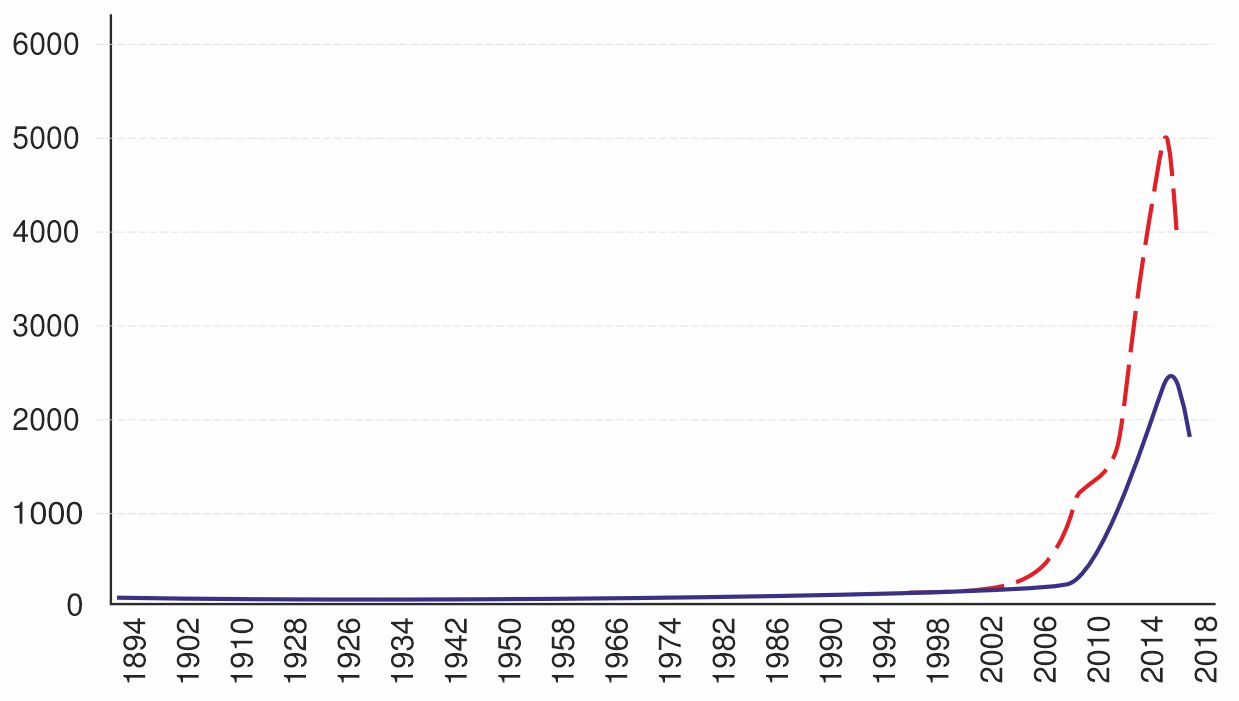
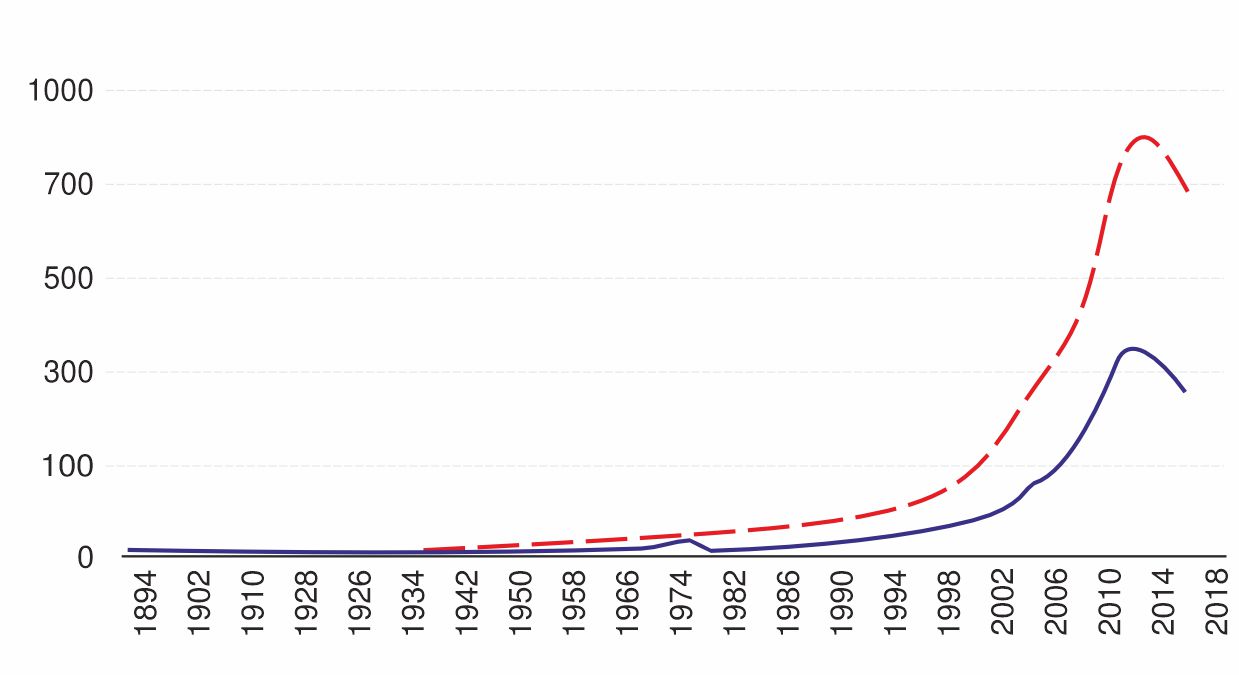
On 8.10.2018 in Scopus more than 268 thousand documents on the request “systematic review” in the titles of articles, short descriptions and keywords and more than 3 thousand – on the request “integrative overview” OR “integrative review”; in the Web of Science – more than 174 thousand publications and more than 2,6 thousand documents, respectively were found.
Data obtained in Scopus and Web of Science data on the number of publications for each year (figures 1, 2) indicate that the number of such publications increases annually, steady growth of systematic reviews, began since the 1990s, and that of integrative - since the 2000s.

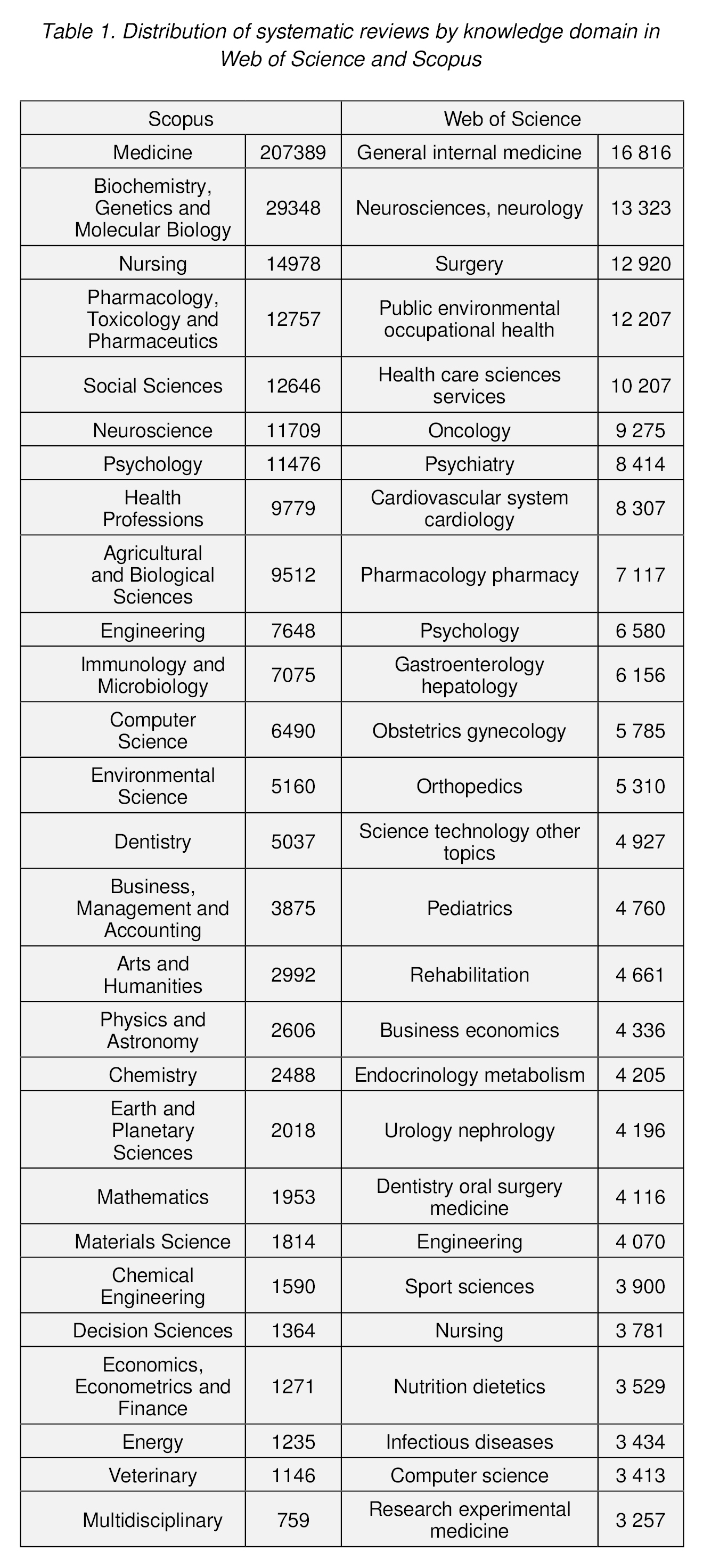
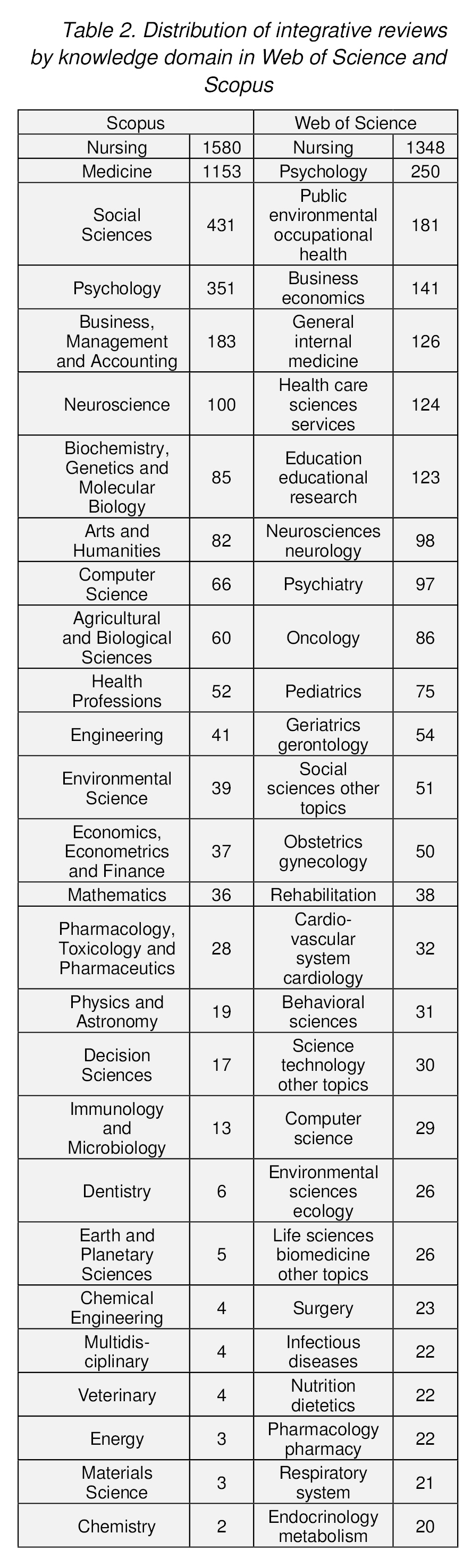
The analysis of document flow by knowledge domain (directions of research) showed that systematic and integrative reviews predominate in the field of medicine, a significant number of publications can also be observed in biochemistry, nursing, psychology, sociology, etc. (Tables 1, 2).
The information presented in Web of Science and Scopus allowed to obtain data on the affiliation of authors taking part in writing reviews under investigation (tables 3 and 4).
Tables 3 and 4 provide the rating list (only 10) of authors’ affiliations in the Web of Science and Scopus databases involved in the preparation of systematic and integrative reviews. All in all Scopus gives authors from 160 organizations participated in wring systematic (78% of them being universities) and integrative (91% of them being universities) reviews. Web of Science gives authors from 40 484 organizations participated in wring systematic (18% of them being universities) and 2126 organizations participated in wring integrative reviews (52% of them being universities).
As one can see, educational institutions, including medical universities prevail in the lists, there are no libraries in them, however, a more detailed analysis of the publications themselves, content analysis of affiliations of all authors allow to discover that employees of libraries of foreign universities take part in the preparation of reviews [22–32].
Discussion
Typological analysis of systematic and integrative reviews
Among the publications on reviews there are three categories of documents: 1) reviews themselves; 2) articles on library and information research (preparation of reviews and analytical products on science and practice in library science and informatics) [23, 25, 27–29, 32]; 3) publications on the contribution of librarians as research partners to scientific activities (including the role of a librarian in the working group on preparing systematic and integrative reviews) , written by specialists, not dealing with library science and practice and informatics [22, 24, 28, 30].
However, practically there are no publications on features and, most importantly, comparative analysis of analytical, systematic and integrative reviews. Understanding species differences is essential for librarians involved in the production of these types of information and analytical products. Therefore, a typological analysis of systematic and integrative reviews was carried out.


From the words themselves - “systematic review”, “integrative review” – it is clear that they are a kind of overview information. Therefore, there is a need to compare them with the analytical review.
For this purpose, the definitions of the concepts “systematic review”, “integrative review” were considered. The settled definitions were not found. Therefore, the authors of the analyzed publications give their interpretation of terms, trying to reflect in them essential characteristics and that, that differ them from other types of information and analytical products. The most characteristic definitions of systematic and integrative reviews are given in the Table 5.
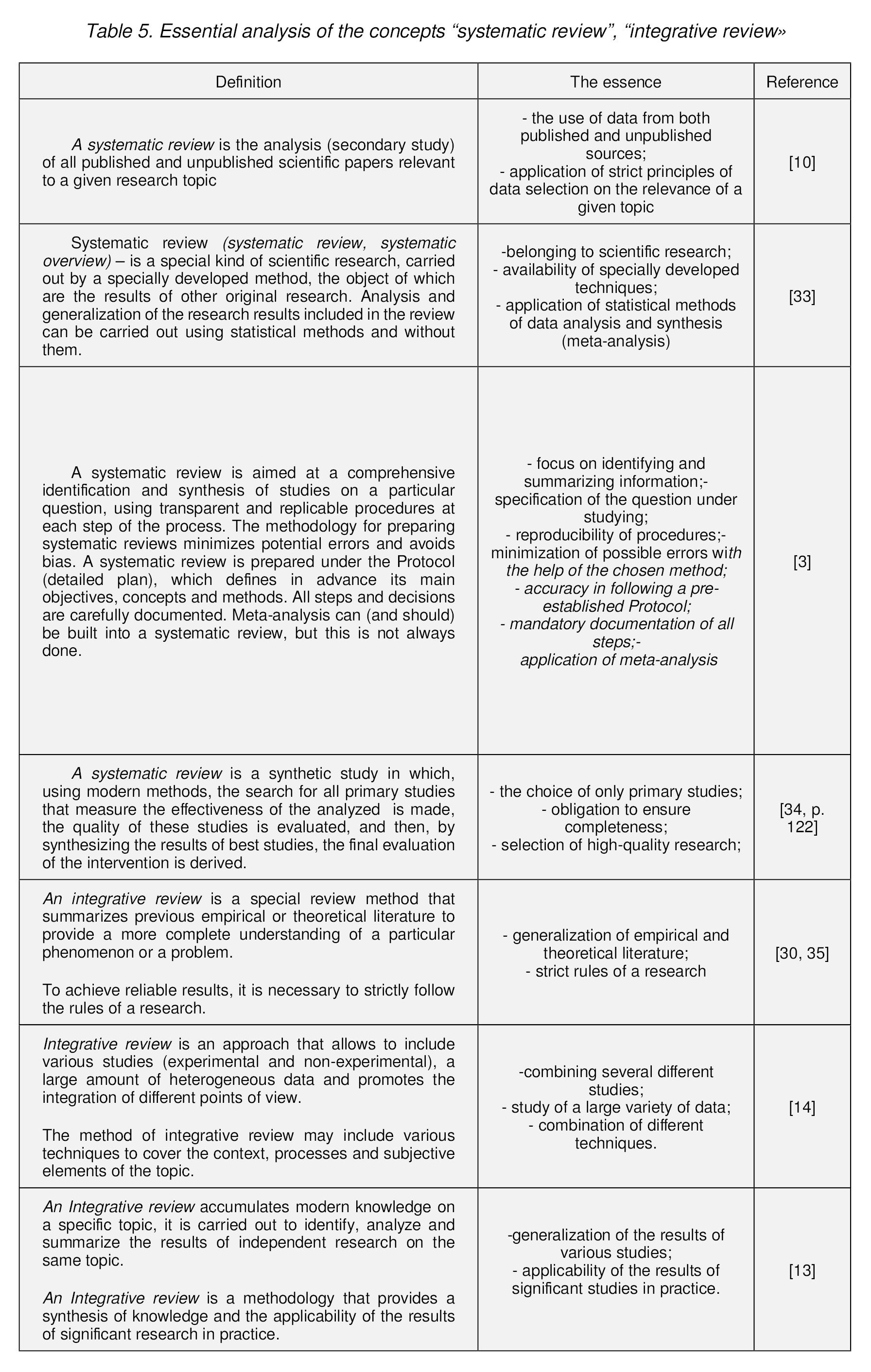

The analysis of the table and comparison of the essence of systematic and integrative reviews with that of analytical1 and abstract2 ones showed that both systematic and integrative reviews have the features of these reviews: the abstract component is determined by a clear systematization of the selected material, and analytical – in obtaining new data, original conclusions.
In order to clearly distinguish systematic and integrative reviews from the analytical one, the study of publications on the method of their preparation [1, 2, 6, 10, 13–15, 30, 35–38] was made and identified the following categories: purpose, topics, compilers, data sources, search strategy, principles of data selection, methods of evaluation of data, methods of information analysis, synthesis and presentation of data, findings and results. The results of this work are reflected in the Table 6.

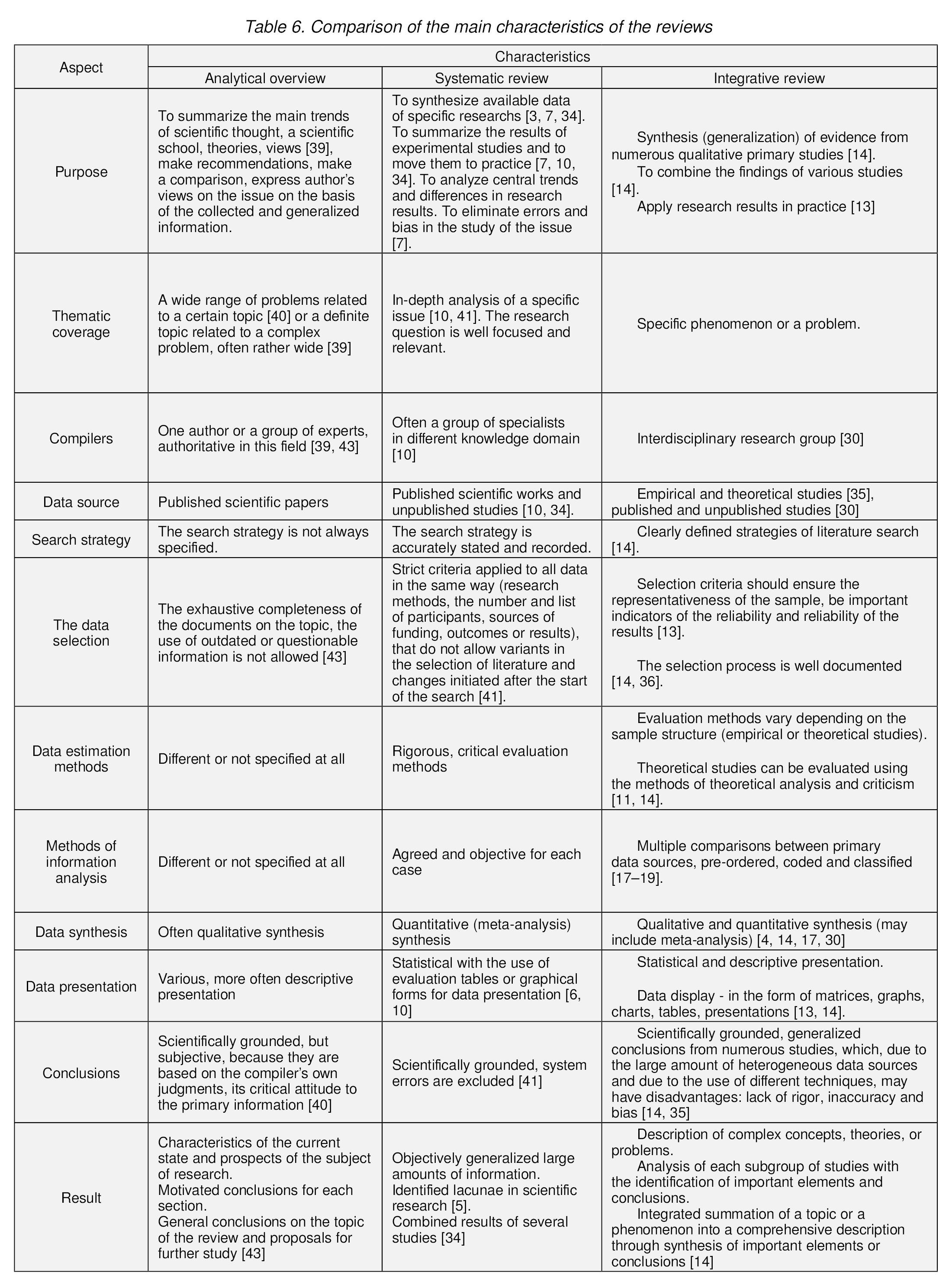
A comparison of the main characteristics of the analytical, systematic and integrative reviews revealed common and distinctive features of these types of information and analytical products.
The common features are:
1. Generalization, synthesis, integration of data from primary sources on the subject of the review.
2. Only highly qualified specialists can be their compilers.
3. Adherence to the principles of completeness and comprehensiveness when searching data for the review.
4. Scientific methods of data evaluation and methods of information analysis.
5. Scientifically grounded synthesis and presentation of data.
6. Scientifically grounded conclusions.
Distinctive features are:
1. Data sources for the analytical review are publications (and theories, scientific views, described trends, i.e. scientifically meaningful and revised research results are analyzed and synthesized), for the systematic review - published and unpublished results of empirical research, and for the integrative review - published and unpublished results; empirical and theoretical research.
2. The authors of the analytical review should be competent in the subject matter of the review and their range is usually limited, as personal authoritative authorship is required, and systematic and integrative reviews can be prepared by a group of authors of various specialties, including professional statisticians.
3. In preparing the analytical review, the principle of completeness is maintained at the stages of data search and selection, and the selection of sources is mandatory and subject to strict criteria for the preparing a systematic review.
4. Methods of data evaluation and information analysis when preparing an analytical review may not be specified, and when preparing systematic and integrative ones they are strictly fixed.
5. In the analytical review generalization and presentation of data are, as a rule, qualitative and descriptive, in the systematic one – rather quantitative with the use of graphical forms of data presentation, in the integrative one – quantitative and descriptive.
6. In the analytical review the conclusions are subjective, in the systematic one they are strictly objective, excluding system errors, in the integrative one - due to the large amount of heterogeneous data sources and the use of different techniques, there may be inaccuracies and subjectivism.
A comparative analysis of a librarian functions at different stages of information analytical products preparing
Very little experience has been found in the literature describing the involvement of library staff in preparing systematic and integrative reviews. For example, the author of [30] considers a librarian as a member of the team of specialists ready to conduct the meta-analysis and preparing an integrative review. Не determines his (or her) possible functions at each stage of the research process (cited from to [36]): (1) problem statement, (2) data collection, (3) data evaluation, (4) analysis and interpretation, and (5) public presentation of the research results.
The paper [24] analyzes the role of an expert librarian in each of the seven steps of preparing a systematic review, which are defined in the Cochrane community guidelines: (1) formulation of the task, (2) search and selection of studies, (3) evaluation of the quality of research, (4) selection of sources (5) analysis and presentation of results, (6) interpretation of results, (7) update of results.
For many years the authors of the article were dealing with preparing analytical reviews on environmental problems [44]. Thus, we can compare functions of a librarian engaged in preparing different types of reviews basing on the algorithm or stages of reviews preparing (Table 7).
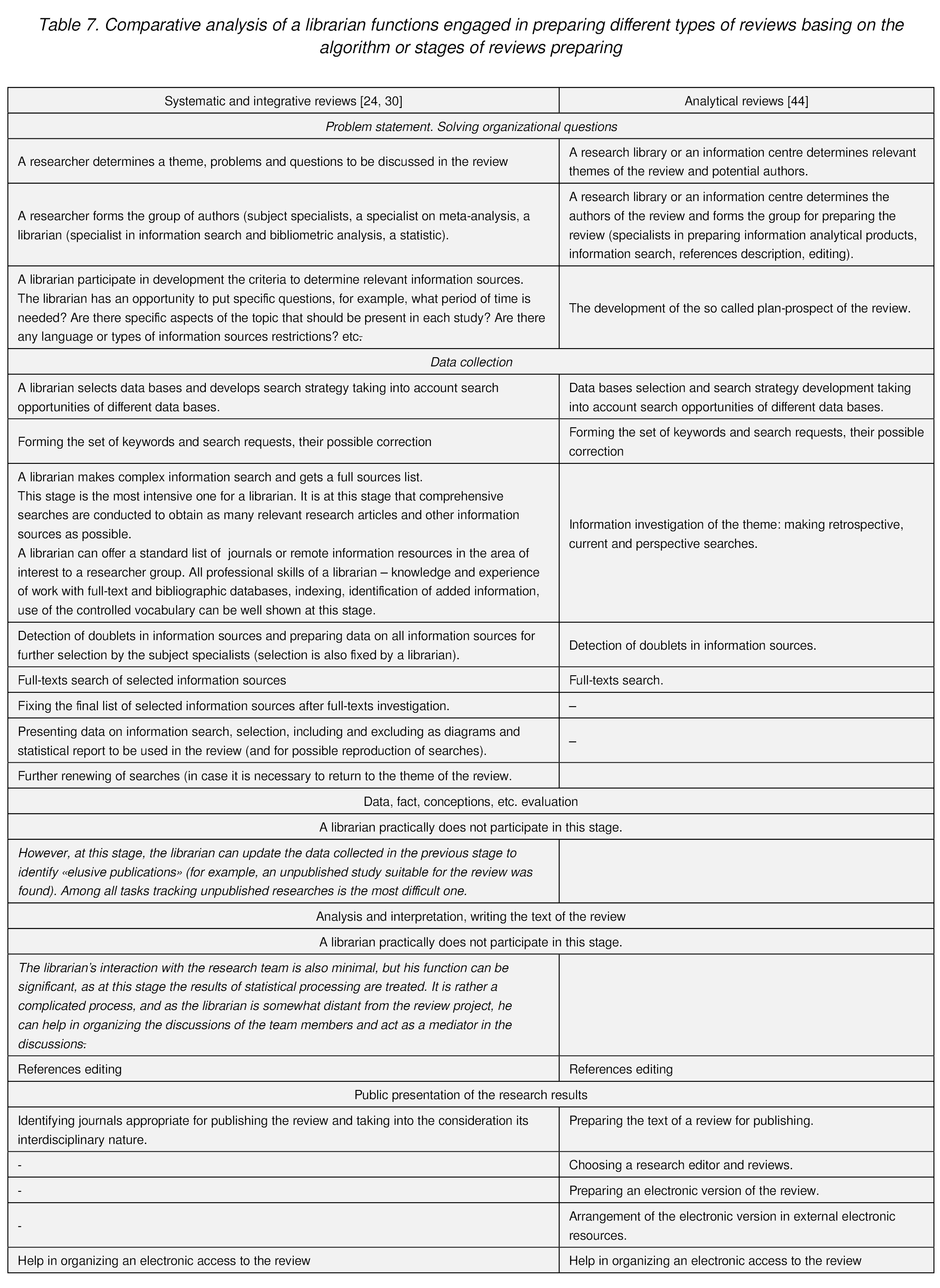

As one can see in the Table 7 a librarian has his important niches in preparing systematic and integrative reviews, although his role is usually minimal at the stages of Data evaluation and Analysis and interpretation. In case of systematic and integrative reviews a librarian is in the author group, and in that of the analytical one he just participates in information search, references editing. And only a subject specialist can include a librarian’s name to the authors’ list. But it is a library or information centre that can initiate an analytical review and survey its preparing.
Conclusion
The presented data on the publications dynamics of systematic and integrative reviews showed their high relevance as analytical information products, especially in the field of medicine, biochemistry, social sciences.
It was determined that analytical, systematic and integrative reviews as a type of analytical information products have both common and special characteristics. The knowledge about them can increase the involvement of library staff in preparing these types of reviews.
Moreover, it is supposed that combined with the bibliometric methods of research fronts determination a research library could offer the themes and problems for systematic and integrative reviews and organize authors teams for their preparing. Certainly, a librarian included in such a team should possess very high knowledge in the essence of information analytical products and information analysis and high skills in heterogenic information search.
Thus, libraries can expand their list of analytical information products and services that they provide to scientists and specialists.
References
1. Glasziou P, Irwig L, Bain C, Colditz G (2001) Systematic reviews in health care. Cambridge University Press, Cambridge
2. Kitchenham B et al. (2009) Systematic literature reviews in software engineering – a systematic literature review. Inform Software Tech 51(1): pp 7–15
3. Kitchenham B (2007) Guidelines for performing Systematic Literature Reviews in Software Engineering. EBSE Technical Report, Keele University & Department of Computer Science University of Durhamm
4. Knafl KA, Webster DC (1988) Managing and analyzing qualitative data: a description of tasks, techniques, and materials. Western Journal of Nursing Research 10: 195–210
5. Kotel’nikov GP & Shpigel’ AS (2000) Sistematicheskie obzory i meta-analiz. Dokazatel’naya medicina. Nauchno-obosnovannaya medicinskaya praktika (pp. 87–93). Samara: SamGMU. (In Russ.)
6. Lau J, John PA, Christopher HS (1997) Quantitative synthesis in systematic reviews. Ann Intern Med 127(9): 820–826
7. Littell Julia H, Corcoran Jacqueline, Pillai Vijayan (2008) Systematic Reviews and Meta-Analysis. Oxford University Press
8. Petticrew M (2001) Systematic reviews from astronomy to zoology: Myths and misconceptions. British Medical Journal
9. Sutton AJ, Abrams KR, Jones DR, Sheldon TA, Song F (1998) Systematic reviews of trials and other studies. Health Technology Assessment 2 (19)
10. Torgerson CJ (2003) Systematic Reviews. Continuum, London
11. Whittemore R (2005) Combining Evidence in Nursing Research. Nursing Research 54 (1): 56–62. DOI: 10.1097/00006199-200501000-00008
12. Russell CL (2005) An overview of the integrative research review. Progress in transplantation 15(1): 8–13. DOI: 10.7182/prtr.15.1.0n13660r26g725kj
13. Tavares de Souza Marcela, Dias da Silva Michelly, Rachel de Carvalho (2010) Integrative review: what is it? How to do it? Einstein 8 (1). DOI: http://dx.doi.org/10.1590/s1679-45082010rw1134
14. Whittemore R, Knafl K (2005) The integrative review: updated methodology. Journal of Advanced Nursing 52 (5): 546–553. DOI: https://doi.org/10.1111/j.1365-2648.2005.03621.x
15. Conn VS, Valentine JC, Cooper HM, Rantz MJ (2003) Grey literature in meta-analyses. Nursing Research 52: 256–261
16. Jackson G (1980) Methods for integrative reviews. Review of Educational Research 50: 438–460
17. Miles MB, Huberman AM (1994) Qualitative Data Analysis. Sage Publications, Thousand Oaks, CA
18. Patton MQ (2002) Qualitative Research and Evaluation Methods. Sage Publications, Thousand Oaks, CA
19. Tashakkori A, Teddlie C (1998) Mixed Methodology: Combining Qualitative and Quantitative Approaches. Sage Publications, Thousand Oaks, CA
20. Green KE, Taylor CA, Torgerson C (2012) An overview of systematic reviews in medical education and a focused review in prescribing. Effective Education 4(2): 147–167
21. Monasta L, Batty GD, Cattaneo A, Lutje V, Ronfani L, Van Lenthe FJ (2010) Early-life determinants of overweight and obesity: a review of systematic reviews. Obes Rev 11 (10): 695–708
22. Borrego A, Ardanuy J, Urbano C (2018) Librarians as Research Partners: Their Contribution to the Scholarly Endeavour Beyond Library and Information Science. Journal of Academic Librarianship 44, 5: 663–670. DOI: 10.1016/j.acalib.2018.07.012
23. Brettle A (2009) Systematic Reviews and Evidence Based Library and Information Practice. Evidence Based Library and Information Practice 4, 1: 43–50
24. Harris MR (2005) The librarian’s roles in the systematic review process: a case study. Journal of the Medical Library Association 93, 1: 81–87
25. Ke Q, Cheng Y (2015) Applications of meta-analysis to library and information science research: Content analysis. Library & Information Science Research 37, 4: 370–382. DOI: 10.1016/j.lisr.2015.05.004
26. Koufogiannakis D (2012) The State of Systematic Reviews in Library and Information Studies Comment. Evidence Based Library and Information Practice 7 (2): 91–95. DOI: https://doi.org/10.18438/B8Q021
27. Koufogiannakis D, Crumley E (2006) Research in librarianship: issues to consider. Library Hi Tech 24, 3: 324–340. DOI: 10.1108/07378830610692109
28. McKibbon KA (2006) Systematic reviews and librarians. Library trends 55: 202–215. DOI: 10.1353/lib.2006.0049
29. Phelps SF, Campbell N (2012) Systematic reviews in theory and practice for library and information studies. Library and Information Research 36, 112: 6–15
30. Smith JT (1996) Meta-Analysis: The Librarian as a Member of an Interdisciplinary Research Team. Library Trends 45 (2): 265–279
31. Wilson V (2016) Research methods: systematic reviews. Evidence Based Library and Information Practice 11, 1(S): 60–62. DOI: 10,18438 / B8M324
32. Xu J, Kang Q, Song Z (2015) The current state of systematic reviews in library and information studies. Library & Information Science Research 37, 4: 296–310. DOI: 10.1016/j.lisr.2015.11.003
33. StudopediYA. (2014) Sopostavlenie dokazatel’stv. Retrieved July 10, 2018, from https://studopedia.info/3-5235.html. (In Russ.)
34. Vlasov VV (2005) Ostorozhno chelovek! Sistematicheskij obzor kak sredstvo ot opasnyh vmeshatel’stv. CHelovek, 3, 121–129. (In Russ.)
35. Broome ME (1993) Integrative literature reviews for the development of concepts. Concept Development in Nursing. In: Rodgers BL, Knafl KA (eds) W.B. Saunders Co., Philadelphia
36. Cooper HM (1984) The Integrative Research Review: A systematic approach. Sage Publications, Beverly Hills, Calif
37. Jadad AR, Moher D, Klassen TP (1998) Guides for reading and interpreting systematic reviews: II. How did the authors find the studies and assess their quality? Archives of Pediatric and Adolescent Medicine 152: 812–817
38. Smith JТ, Smith MC, Stullenbarger E, Foote A (1994) Integrative review and meta-analysis: An application. Medical Reference Services Quarterly 13 (1): 57–72
39. Vinogradov VA (1978) Obshchestvennye nauki i informaciya. Moskva: Nauka. (In Russ.)
40. Grechihin, A. A., & Zdorov, I. G. (1979). Informacionnye izdaniya: osnovnye osobennosti i trebovaniya. Moskva: Kniga
41. Dokazatel’naya medicina. Sistematicheskie obzory. Metaanaliz. (2017). Retrieved May 15, 2017, from http://zodorov.ru/dokazatelenaya-medicina-sistematicheskie-obzori-metaanaliz.html. (In Russ.)
42. Chernyj YU (2008) Shkola nauchnoj informacii. Lekciya 4. Dokumental’nye istochniki informacii. Vtorichnye dokumenty i izdaniya (chast’ 1). Retrieved July 10, 2018, from http://archive.bogoslov.ru/text/316300.html (In Russ.)
43. Starikova LN (1998) Informacionnoe obespechenie sociologicheskogo obrazovaniya: resursy, tekhnologii. Kemerovo: Kuzbassvuzizdat. (In Russ.)
44. Lavrik OL & Kalyuzhnaya TA (2000) Internet kak istochnik informacii dlja podgotovki nauchnogo obzora. In Optimizacija informacionno-bibliograficheskogo obsluzhivanija uchenih i specialistov (pp. 51–57). Novosibrsk. (In Russ.)