 10.34920/2181-8207/2024/4-146

Annotation: Hanji is Korean traditional paper. It was called «Gyerimji» and «Goryeoji» during the period of Silla and Goryeo kingdom, respectively, which are two of the former Korean nations. Many records have been passed down regarding the superior quality of Hanji in Chinese documents. Based on the development of Hanji, Korea’s publishing culture flourished, allowing the country to produce both the world’s oldest woodblock print and the oldest metal type print. Of the 18 Memory of the World Korea possesses, 11 are books or documents made from Hanji, and two are woodblocks used for printing books. Recently, Hanji was used in Italy to restore Leonardo da Vinci’s writings. Additionally, Hanji has been used as a material to make various everyday items. Korea was able to develop paper manufacturing and a publishing culture from ancient times due to the national management of the cultivation of Daknamu (Broussonetia kazinoki) trees, the raw material for Hanji, ensuring a continuous supply. After Joseon dynasty, which is one of the former Korean nations, the government established an institution to oversee the production of Hanji, making its supply and demand more systematic. The process of making Hanji involves several steps, including harvesting Daknamu shoots, steaming for peeling, scrapping the outer bark to leave white bark (Baekpi), boiling Baekpi, refining Baekpi, and sheet-forming. There are two types of sheet-forming: one using a tool equipped with a deckle and the other using a tool without a deckle. The latter is called Heulimtteugi which is unique to Korea. Hanji made using Heulimtteugi technique is highly durable and dimensionally stable.
Аннотация: Ханджи — это корейская традиционная бумага. Она называлась «Gyerimji» и «Goryeoji» в период правления королевств Силла и Корё, которые являлись двумя бывшими корейскими странами. На основе развития производства ханджи, корейская издательская культура процветала, что позволило стране производить как старейшую в мире ксилографию, так и старейшую металлическую печать. Из 18 номинаций Памяти мира, которыми владеет Корея, 11 — это книги или документы, изготовленные из ханджи и два — это ксилографии, используемые для печати книг. Недавно ханджи использовали в Италии для реставрации произведений Леонардо да Винчи. Кроме того, ханджи использовали в качестве материала для изготовления различных повседневных предметов. Корея смогла развить производство бумаги и издательскую культуру с древних времен благодаря Национальному управлению по выращиванию деревьев дакнаму (Broussonetia kazinoki), сырья для ханджи, что обеспечивало непрерывные поставки. После правления династии Чосон, правительство создало институт для надзора за производством ханджи, сделав его предложение и спрос более систематизированными.
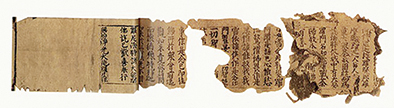
Korea published the world’s first woodblock print, the «The Great Dharani Sutra» (751) and the world’s first metal type print, «Jikji» (1377) (Fig. 1). Korea also holds eighteen Memory of the World, which is the largest number in Asia-pacific countries. Eleven of the eighteen are books or documents written on paper, and two are woodblocks for printing books. Paper has played a significant role in Korea’s literary culture, printing, and publishing. The traditional paper of Korea is currently called Hanji. (Fig. 1)
It is inferred that the history of Hanji production began not long after the invention of paper in China, due to Korea’s geographic proximity and frequent cultural exchanges with China. The oldest known Hanji artifact is the «Lotus Sutra» from the Goguryeo period, housed in the Central History Museum of North Korea, and it is believed to have been made in the 4th or 5th century (Lee et al., 2021). In South Korea, artifacts such as the «The Great Dharani Sutra» and the «Avatamsaka Sutra» (754) (Fig. 2) have been discovered.
Paper-making techniques from China spread to Japan through Korea. According to the Japanese historical text «Nihon Shoki,» a monk from the ancient Korean kingdom of Silla, named Damjing, introduced paper-making techniques to Japan in 610 (Kume, Y., 2012).
Paper was treated as an important commodity from old times in Korea. In 1415, the government established an institution for the production and management of paper used for currency. This institution expanded in 1446 to manage the production of paper for various purposes, such as writing and publishing, and it remained in operation until 1882 (Lee et al., 2021).
Korean paper was known for its excellent quality, as documented in various books from Chinese dynasties such as the Song, Yuan, Ming, and Qing (Xing, P. ,2002). One of the early records is that « Gyerimji, the paper of Silla in 700’s, was as white and smooth as a mirror» in book «Qing Yi Lu» written by Tao Gu (903-970) in 964. In particular, during Korea’s Goryeo dynasty, Korean paper was praised in China as «Goryeoji» for being of the highest quality (Xing, P. ,2002). Recently, Hanji’s excellence has become known in Europe and the United States. Italy and the Vatican have recognized the superiority of Hanji and used it to restore many relics. One such example is Leonardo da Vinci’s «Codex on Bird Flight,» known to have been produced between 1503 and 1506 (Lucilla, 2021). The reason Hanji was used for such valuable relics is that it is strong yet soft and resistant to tearing (Poggi, 2016).
Hanji has been used for various purposes beyond writing and painting. Its durability made it suitable for use as interior materials such as window paper, wallpaper, and floor paper, as well as for making everyday items (Fig. 3) like umbrellas, fans, containers, and pouches. Paper for flooring, umbrellas, and pouches was especially treated with oil for waterproofing. Additionally, thin paper was cut into narrow strips, twisted into threads to make clothing, and formed into various types of vessels.
The characteristics of Hanji result from a combination of factors, including raw materials, pre-treatment of materials, and paper-making techniques. Notably, Korea developed a unique sheet-forming method that allowed for the production of durable paper

RAW MATERIALS OF HANJI
The primary raw material of Hanji is the bast fiber from the bark of Daknamu (Broussonetia kazinoki). It is widely known that this fiber has been the main ingredient in Korean paper, as evidenced by Korean paper artifacts from the 8th century and throughout other historical periods (Park, 1999). Historical records from the Joseon dynasty mention that due to shortages of Daknamu bark fiber, rice straw and other plants were sometimes used as paper materials (Lee et al., 2021). However, these were not the primary ingredients but rather additives, with Daknamu bark fiber remaining the main material.
In contrast, the primary material for Chinese paper from the Han to the Sui and Tang dynasties is reported to have been hemp fiber. According to Chinese records, early paper-making materials included old fishing nets and ropes, which were made of hemp fiber. More than 80% of papers made before the Tang dynasty excavated from the Dunhuang caves or Xinjiang province were made from hemp fiber (Xing, P. ,2002). From the 9th and 10th centuries onward, bamboo fiber became widely used in China for paper production, and more recently, they have been using various materials like rice straw and the bark of blue sandalwood (Pteroceltis tatarinowii) to manufacture paper (Xing, P. ,2002).
In Japan, Daknamu or Kozo (Broussonetia kazinoki), Mitsumata (Edgeworthia chrysantha), and Gampi (Wikstroemia trichotoma) plants are commonly used as paper materials (Kume, Y., 2012). These differences in raw materials in those countries seem to be related to the vegetation of each region. The Daknamu grows naturally in Korea and Japan, while Mitsumata and Gampi are native to Japan and China. Although some plant species were introduced and used as paper materials across Korea, China, and Japan, the most commonly used raw materials were native plants. As a result, Daknamu bark fiber became the primary raw material for paper in Korea.
Korea has numerous historical records regarding the management of plants used for paper-making. According to records from the Goryeo-sa (History of the Goryeo kingdom), written in 1145 and 1188, the state encouraged the cultivation of Daknamu and other plants on barren lands unsuitable for farming. By the 1400s, during the Joseon dynasty, the demand for paper surged due to the expansion of state publishing projects and increased international exchanges. To meet this growing demand, the government systematically managed the planting and cultivation of Daknamu. During King Sejong’s reign, for instance, barren lands were used to plant Daknamu, and local government offices were provided with fields for this purpose. The «Geographical Records of the Annals of King Sejong» published in 1432 notes that Daknamu were already being planted in most regions of Korea with the bark being collected as a tribute to the state.
The bast fiber of Daknamu comes from its inner bark. On average, the fiber length is about 10 mm, and the width is approximately 20 μm. According to measurements from the National Institute of Forest Science of Korea the average tensile strength of individual fibers is 3,016 N/mm², which is about half that of carbon fiber, making it an incredibly strong natural fiber.
PREPARATION OF THE MATERIALS
Harvesting Daknamu Shoot
The part of Daknamu used to make Hanji are primarily 1- to 2-year-old shoots. Typically, they are cut about 5 cm above the stump between November and December. From the cut stumps, new sprouts will grow the following spring.
Steaming Daknamu Shoot
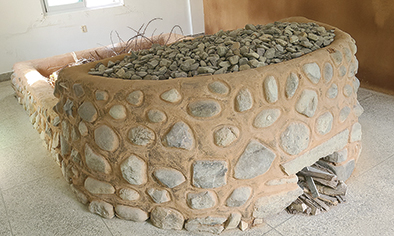
The harvested Daknamu shoots need to be steamed to peel off their bark easily. And then the outer bark is scraped off, dried, and stored after the peeling. Steaming the shoots requires special facilities (Lee et al., 2021). The traditional steaming facility shown in Fig. 4 involves heating stones and pouring water over them to generate steam. The facility consists of two sections: one for heating the stones and the other for stacking the Daknamu shoots. The two spaces are connected by an air passage that allows steam to flow through. Part (a) of Fig. 4 shows the steam generation device, where a fire is lit under a pile of stones. When the stones are heated, water is poured over them to produce steam. The Daknamu shoots are piled up at the space connected to the back of the steam generator as shown in (b) of Fig. 4. Stones stacked at the boundary between the two areas are not sealed with mud, allowing the steam to pass through. Before steaming, the Daknamu shoot piles are covered with twigs and soil to prevent the steam from escaping. The steaming process involves heating the stone pile for 4 to 5 hours, covering it completely with twigs and soil. A small section of the soil is uncovered to pour water, which is then covered again to prevent the steam from escaping. The steam enters to the space of Daknamu shoot, and Daknamu shoots are steamed for about 4 to 5 hours.
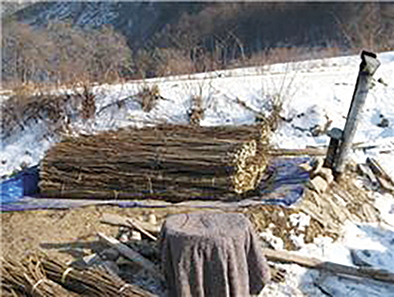
However, most modern Daknamu shoot steaming processes are done using an improved method. An outdoor furnace-like facility is built, and a large rectangular metal tray is placed above it. In Fig. 5, the metal tray is covered with plastic. The tray is filled with water, and the Daknamu shoots are stacked on top. The pile is then sealed to prevent the steam from escaping, and a fire is lit in the furnace, steaming the branches for 4 to 5 hours.
Preparing the Inner Bark (Baekpi) of the Daknamu shoot
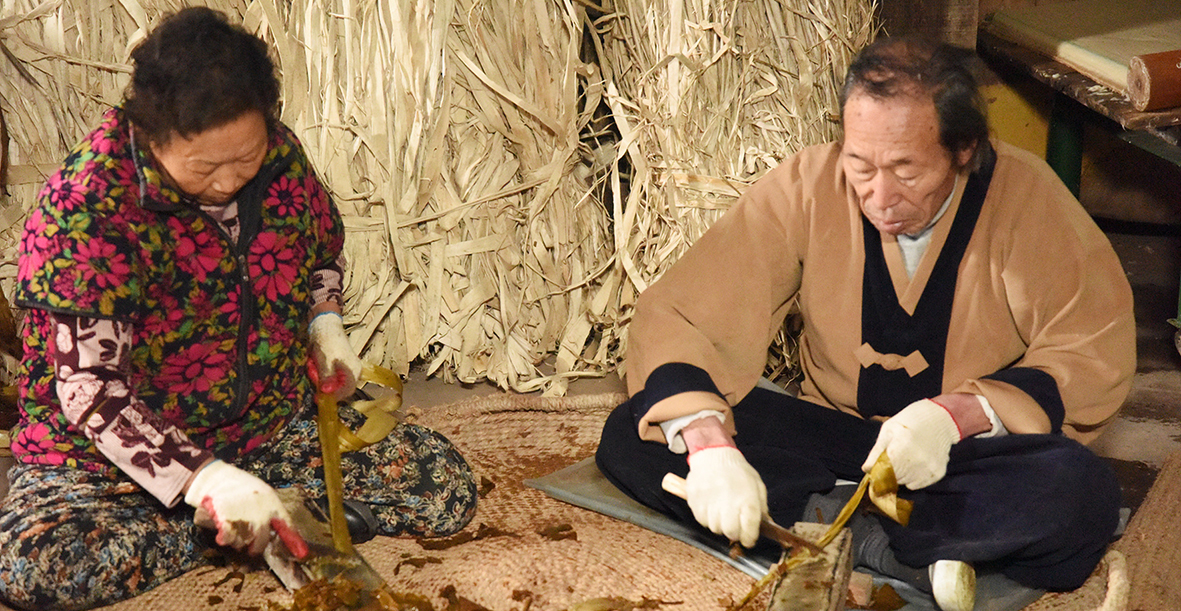
During the steaming process, steam or moisture penetrates between the bark and the wood, making it easy to peel the bark off the Daknamu shoot. The outer bark is scraped off using a knife, revealing the white inner bark, which is known as «Baekpi» and serves as the raw material for Hanji (Lee et al., 2021). When preparing Baekpi, care must be taken to completely remove any outer bark and blemishes. If not properly removed, these impurities may show up on the paper, especially if Hanji is being produced, resulting in defective paper. Any leftover Baekpi should be dried in the sun and stored in a dry place. When needed, it can be soaked in water for later use.
Boiling Baekpi
To use Baekpi as paper material, it must first go through a boiling process to remove non-fibrous substances. The Baekpi is cut into pieces about 50 cm long and boiled in lye solution for 3 to 5 hours. If the Baekpi has been dried, it is soaked in water overnight before being cut and boiled. In the past, ashes from kitchen stoves were collected and used to make lye, but nowadays, ash from burning agricultural waste, such as soybean stalks or straw, is washed in hot water to produce lye. The appropriate pH for boiling Baekpi is around 11. In modern times, sodium carbonate (Na2CO3) is often used as a substitute for lye, as ash is harder to obtain. Once Baekpi has been boiled, it is rinsed thoroughly with clean water to remove any remaining lye residue.
Bleaching the Boiled Baekpi
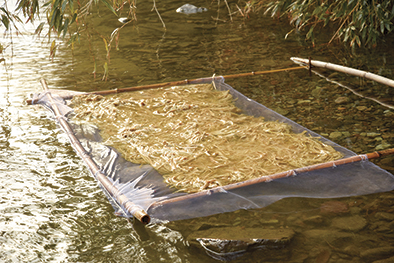
After boiling and washing, the boiled Baekpi is bleached to whiten it. Traditionally, this was done by exposing it to sunlight. The Baekpi is spread out in flowing water or immersed in water and it is flipped and stirred frequently to ensure even exposure to the sun (Fig. 6). On sunny days, the process takes 3 to 5 days, while cloudy days require about a week. This process is known to cause oxidation bleaching due to the oxygen species formed by oxygen reaction in sunlight. Although this natural bleaching method is time-consuming and weather-dependent, it has the advantage of causing less damage to the fibers than chemical bleaching, resulting in stronger Hanji.
Removing Impurities
Any remaining impurities in the boiled Baekpi, after lye has been removed and/or the bleaching has done, are carefully picked out by hand. This step is critical, as it directly affects the quality of the paper.
Beating the Baekpi
The prepared Baekpi is then placed on a stone and beaten with a mallet for 1 to 2 hours to perform the pulping in the traditional way. In modern times, mechanical equipment such as a stamper or knife beater is sometimes used for beating Baekpi.
HANJI-MAKING
The beaten Baekpi is placed in a rectangular container filled with water. Subsequently, the beaten Baekpi is stirred vigorously with a bamboo stick to ensure it disperse well in fibrous form. A mucilaginous substance, such as mucilage from the roots of Abelmoschus manihot or elm tree, is then added and mixed again to further disperse the fibers throughout the container. Once the raw materials are ready, the paper is manufactured using Hanji -making tools.
Hanji-Making Tools and Methods
There are two types of tools used to make Hanji. One is Gadeumtteugi tool and the other is Heulimtteugi tool. Gadeumtteugi tool consists of a frame, a screen, and a deckle to hold the paper fibers temporarily within the frame, while Heulimtteugi tool uses only a frame and a screen. Gadeumtteugi method is the most widely used traditional paper-making technique in both the East and West. On the other hand, Heulimtteugi method is unique to Korea and has commonly been using in Korea.



In Gadeumtteugi process, the fibers are scooped from the container and temporarily held in place by the deckle and screen as water drains through, leaving a thin layer of fibers that form the paper when dried. The process of making paper using a Gadeumtteugi tool can be divided into two methods. One method involves lifting the fibers from the water while maintaining a steady horizontal position without any movement ((a) in Fig. 7). In this method, there is no significant water flow except for the water that drains through the screen. The second method involves shaking the frame back and forth or tilting it to spread the fibers evenly or to create thicker paper by scooping and spreading the mixture multiple times. During this process, complex water flows, such as C- or U-shaped currents, form inside the deckle ((b) in Fig. 7). The complex water flows cause to form paper composed of the curved-shape fibers. Traditional Korean Gadeumtteugi tool is almost disappeared in paper mill in Korea after Japanese one is widespread (Lee et al., 2023).
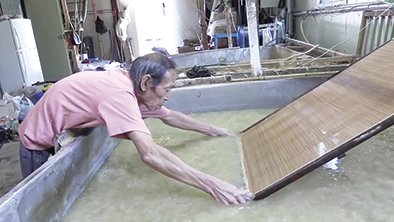
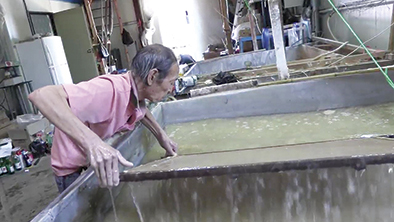
In contrast, Heulimtteugi tool allows the fibers to flow freely because there is no deckle in it. The process involves submerging the tool’s front end into the vat of fiber mixture ((a) in Fig. 8), then lifting it while tilting the tool to let the mixture flow towards the back ((b) in Fig. 8). In the next action, the tool is then dipped on one side and tilted towards the other side after the lifting ((c) and (d) in Fig. 8). And the same action is repeated in the opposite direction. As the fiber mixture flows across the screen, a thin layer of fibers remains to form the paper. The shape of the fibers in paper produced using this method tend to be more linear, as there is no obstruction caused by a deckle like in Gadeumtteugi process. From the first action of scooping and tilting in vertical direction, layer of fibers formed when water flows consists of fibers aligned in the same vertical direction. In the subsequent layers formed by side to side action in horizontal direction, lay over the first with the fibers aligned in perpendicular to those of the first layer. As a result, the fibers in lower and upper layers hold tight perpendicular each other when it dried. This makes Hanji manufactured by Heulimtteugi method physically stable in both horizontal and vertical directions.
Production of Layered-Hanji
Korean have developed a technique to produce layered-Hanji. The process involves couching a wet fiber layer (paper) on top of another wet fiber layer to make a layered-paper. In this process, each subsequent layer is aligned in the opposite direction to the previous one, ensuring complement each other to create paper with uniformity (Lee, 2021). As a result, layered-Hanji composes layers of fibers holding tight in perpendicular each other. This exhibits minimal expansion and contraction, making it dimensionally stable.
Hanji, as traditional Korean paper, has not only played a vital role in Korea’s contribution to the development of global printing culture, but has also served as the foundation for many Memory of the World. Hanji has long been used as a material of writings and paintings and use in the creation of everyday household items. The advancement of Hanji culture in Korea has led to the development of distinctive Hanji-making techniques, especially Heulimtteugi method. This technique produces durable and dimensionally stable paper, often further enhanced by the layered-Hanji-making method to improve its material properties.
References
Kume, Y. (2012). Dictionary of Whashi culture research, Hosei Unversity Press, Tokyo, Japan, p. 4
Lee, O.K. (2021). Origin of Hanji and the specialties in Hanji-making techniques.
Lee, O.-K., KIM, S., and Lee, H. W. (2023). Evolution of the Hanji-making technology, from ancient times to the present. Journal of the Korean Wood Science and Technology 51(6):509-525.
Lee, O.-K., KIM, S., and Lee, H. W. (2024). Studies on the Traditional Hanji Made using A Papermaking Device Equipped with Deckle. Journal of Korea TAPPI. Submitted.
Lee, O.K., Lee, K.T., Lee, H.W., Rho, J.G., Jo, H.J., and Nam, K.H. (2021). A Story of Forgotten Hanji, Park, H.(Ed.), National Institute of Forest Science, Seoul, Korea, p.49
Lucilla, N. (2021). Presentation of ‘La carta tradizionale Hanji e la sua applicazione nel restrauro’. In: Jeonju, Korea, Proceedings of International Symposium on Jeonju Hanji.
Park, C. S. (1999). Paper relics in ancient Korea. The Journal of Korean Studies 106: 9-41.
Poggi, N. (2016). Conservation of the globe papa Giovanni XXIII. In: Kim, S.G., Ahn, J.Y., Lee, K.M., Shin, H.Y., and Son, M.K. (eds), Daejeon, Korea, Proceedings of the International Symposium on Hanji in Italy and Korea, pp. 79-104.
Xing, P. (2002). History of paper-making in China, Cho, B.-M.(Trans.), Gwang-il Press, Seoul, Korea, p.73. 323